Spectral estimation for point processes and random fields
Abstract
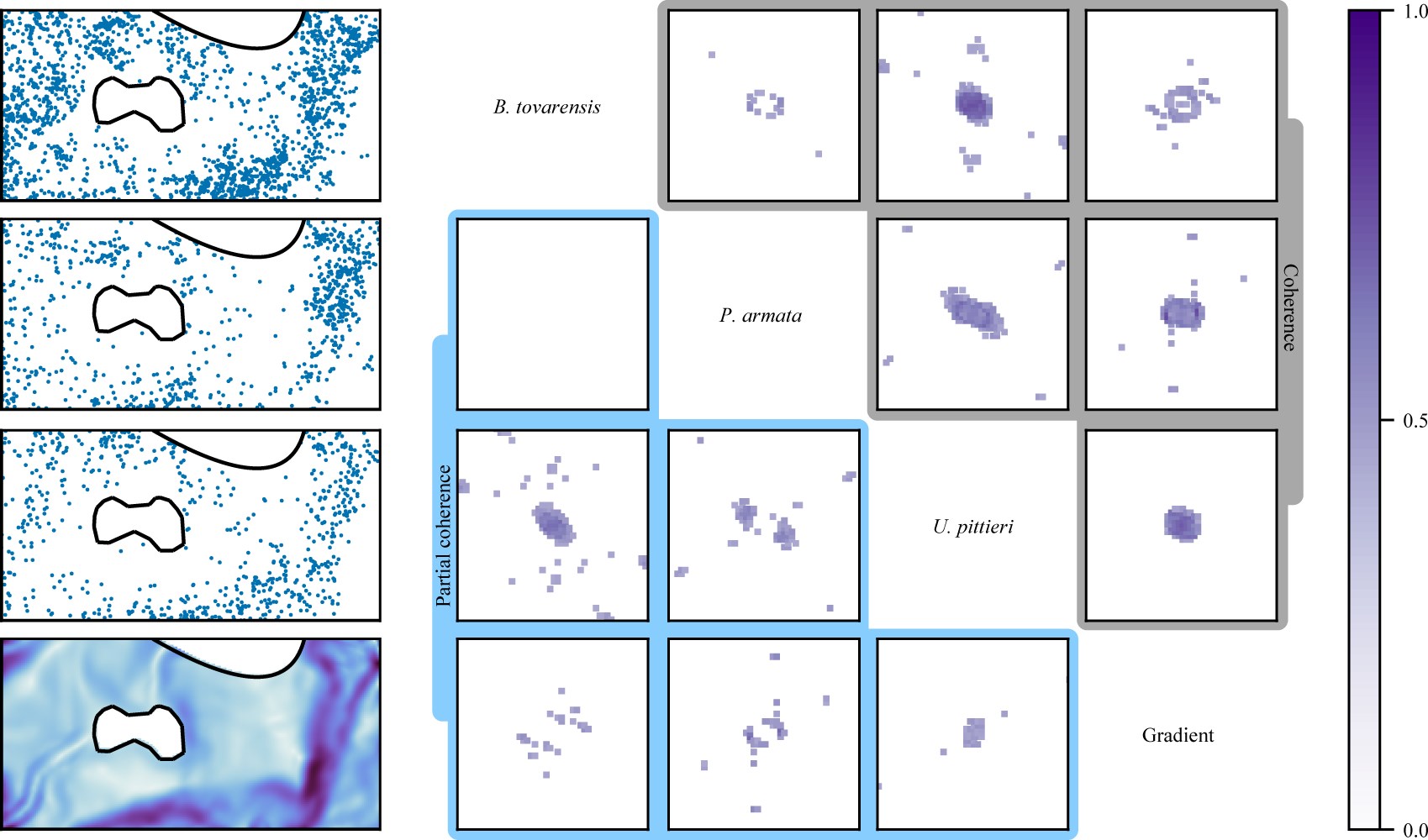
Spatial variables can be observed in many different forms, such as regularly sampled random fields (lattice data), point processes and randomly sampled spatial processes. Joint analysis of such collections of observations is clearly desirable, but complicated by the lack of an easily implementable analysis framework. We fill this gap by providing a multitaper analysis framework using coupled discrete and continuous data tapers, combined with the discrete Fourier transform for inference. Using this set of tools is important, as it forms the backbone for practical spectral analysis. In higher dimensions it is especially important not to be constrained to Cartesian product domains, and so we develop the methodology for spectral analysis using irregular domain data tapers and the tapered discrete Fourier transform. We discuss its fast implementation, as well as the asymptotic and large finite-domain properties. Estimators of partial association between different spatial processes are provided, as are principled methods to determine their significance, and we demonstrate their practical utility using a large-scale ecological dataset.